
Language:


Whenever I think of Japan, the smell of freshly fried batter immediately fills my nose: Takoyaki! These little balls are among the biggest stars of Japanese street food culture. Crispy on the outside, wonderfully soft on the inside and filled with a piece of octopus or another tasty surprise. In Osaka, where they originated, you can find them on every street corner – hot, fragrant and perfect for a quick bite.

What exactly are takoyaki?
Today I’m showing you my delicious recipe for Takoyaki, the famous grilled octopus balls from Japan, which are considered one of the country’s best-known street foods. Originally created in Osaka around 1935, these delicious dough balls have made a name for themselves far beyond the borders of their hometown.
Takoyaki literally means “grilled octopus” and is often also referred to as “octopus balls” or “octopus dumplings”. These small, round snacks traditionally contain pieces of octopus, encased in a soft, flavourful batter. They offer a unique taste experience that delights with its crispy exterior and juicy filling.

In Osaka, the heart of takoyaki culture, you’ll find stalls selling this delicacy on almost every corner. But takoyaki is also a staple on the menus of supermarkets, food courts and specialist restaurants across Japan, Takoyaki is a staple on the menu. They are typically served with a hearty sauce that goes perfectly with beer and other fizzy drinks. This is one reason why they are often found in izakaya restaurants.
TOP RECOMMENDATION

Takoyaki Kochbox | für japanische Oktopusbällchen
6-tlg. Set für 6 Portionen japanische Oktopusbällchen + Anleitung, auch für Anfänger. Mit der Takoyaki Kochbox von 1mal1japan gelingen dir Japans beliebteste Streetfood-Snacks in nur…
Whether traditionally made with octopus or in creative variations, preparing is great fun, especially when done in company, and is a culinary experience that brings friends and family together.
What makes Takoyaki so special?
Takoyaki is known for its entertaining preparation :), which can sometimes be a real challenge – that’s how it was for me at the start. .. Its cultural and historical significance makes it particularly interesting. The recipe originally comes from Osaka, where it was developed in 1935 by Tomekichi Endo, based on an existing recipe from Hyogo Prefecture called “Akashiyaki”.

Unlike its predecessor, Takoyaki uses a wheat flour batter and is prized for its characteristic preparation in a special, dimpled pan that shapes the batter into small balls, each containing a piece of squid.
Osaka, often celebrated for its vibrant street food scene, quickly embraced the grilled balls, and the dish spread rapidly throughout Japan. It became not only a popular snack but also a symbol of Osaka’s playful and innovative culinary spirit. Today, the balls are not only a staple of street stalls but are also prepared in restaurants and even at home, thanks to the availability of Takoyaki pans.
Takoyaki has not only dominated Japanese street food but has also inspired variations and been incorporated into various local and international cuisines. Its handy size and rich flavour make it particularly popular at street events and festivals. Whether it’s the crispy outer shell or the soft, flavourful centre filled with octopus, Takoyaki offers a unique taste experience that captures the essence of Japanese culinary art.
Here’s how to make Takoyaki yourself:
I bet you’re now really keen to make Takoyaki yourself, aren’t you? Then let’s get started: For your homemade octopus balls just like in Japan, you’ll need:
- Takoyaki batter
- Main ingredient for the filling (octopus, Tofu, meat, …)
- Smaller ingredients as a flavourful addition to the filling (beni shoga, Katsuobushi, etc.)
- Takoyaki sauce and mayonnaise
- Toppings (Katsuobushi, Aonori, etc.)
5 ingredients for authentic Takoyaki
1. Batter
This part is very simple: The batter is a mixture of water (or Japanese (vegan) Dashi stock), wheat flour, baking powder and eggs. For a particularly delicious taste experience, I recommend using our Takoyaki flour mix (im Shop ansehen) instead of wheat flour.
This authentic flour (which is also used for Okonomiyaki) contains absolutely no additives or preservatives. What’s more, the wonderful sugar kombu brings the ideal, typically Japanese flavours of the sea without tasting fishy, as sugar kombu, a brown seaweed, is rich in natural glutamic acid – in other words, full of 100% pure flavour. I only use this flour!
2. Main ingredient for the filling
For the classic version, cooked octopus (tako) is traditionally used, which you can often find frozen in Japanese or Asian food shops. If you’re planning a larger celebration, you could even buy a whole octopus from your local fishmonger.
If you’re not a fan of octopus: don’t worry, many people feel the same way! Other fillings are also popular in Japan. Here are a few alternative suggestions you can try:
- Firm Tofu or silken Tofu (im Shop ansehen)
- Kirimochi (im Shop ansehen)
- Tinned tuna, prawns or surimi
- Sausages, cheese or avocado
- Kimchi (im Shop ansehen)
- Corn or edamame

Vegan Takoyaki?
Yes, it is certainly possible to make our Takoyaki vegan or vegetarian. Here are a few tips:
Instead of the traditional filling, you can use Tofu, vegetables or vegetarian/vegan alternatives such as vegan fish fillets . For the eggs, you can use a vegan mixture of flaxseed and water (1 tbsp ground flaxseed + 3 tbsp water). You can replace the Dashi stock with a vegan stock or water.
3. Smaller ingredients as a flavourful addition
Small pieces of Beni Shoga, Katsuobushi and spring onions not only add a splash of colour to the Takoyaki, but also a slightly spicy and tangy note that enriches the flavour of the dish.
Beni Shoga is known for its intense flavours, which harmonise perfectly with the mild and juicy ingredients. You can find this special Beni Shoga ginger in our range, where it is available in its authentic Japanese quality. Ideal for anyone who wants to give their Takoyaki a traditional Japanese touch.
Katsuobushi, also known as bonito flakes, gives the recipe an irresistible Umami depth. These wafer-thin flakes dissolve on contact with the hot balls, creating an explosion of flavour. Discover our range of Katsuobushi, ideal for authentic Japanese cuisine.
Spring onions are another classic ingredient in this dish. Their fresh, slightly pungent flavour provides the perfect contrast to the sweet sauce. Available in our range, these onions add a fresh touch to any dish.
4. Sauce and mayonnaise
Takoyaki sauce, inspired by Worcestershire sauce, gives your balls that classic, slightly sweet-and-sour flavour.
You can buy ready-made sauce or whip up a quick homemade version using various spices. Try our recipe for homemade Takoyaki sauce:
No post found!
Japanese mayonnaise, creamier and slightly sweeter than Western varieties, is the perfect topping for Takoyaki. It gives the balls a rich, velvety texture. Our authentic Japanese mayonnaise is ideal for adding the finishing touch to your Takoyaki – available here.
5. Garnish
As a finishing touch, a pinch of exquisite garnishes is added to your Takoyaki:
Aonori: These dried green seaweed flakes add a subtle sea breeze and enrich every ball with a hint of ocean aroma. Discover our Aonori in our range here.
Katsuobushi: These dried bonito flakes are essential for the authentic recipe. Their unique smoky flavour and crispy texture complement your Takoyaki – available here.
These ingredients not only give your Takoyaki depth of flavour, but also a visually appealing look!
Make it yourself, step by step!
Before we get to the question of what exactly a Takoyaki pan is, here’s a summary of the preparation; you can find the full recipe below!
First, prepare the Takoyaki batter by mixing the flour, baking powder and water (or Dashi stock) in a bowl. Add the eggs and whisk until you have a smooth batter, which you then transfer to a jug with a spout.
First, prepare the Takoyaki batter by mixing flour, baking powder and water (or Dashi stock) in a bowl. Add the eggs and whisk until you have a smooth batter, which you then transfer to a jug with a spout.
Finely chop the filling ingredients such as Katsuobushi, pickled ginger and spring onions, and cut the Tofu into small cubes.
Preheat the pan over a medium heat and grease it generously with sesame oil. Pour the batter into the pan’s indentations, add the filling and cook for about 4–5 minutes. Start turning the Takoyaki carefully as soon as they can be moved. First turn them 90 degrees and press any uneven parts inwards to achieve a round shape.

Pour more batter over the Takoyaki to ensure they are fully filled, and turn them again until they are round and evenly browned.
Remove the finished balls from the pan, brush them with Takoyaki sauce, drizzle with mayonnaise and add further toppings as desired. Serve them hot as a delicious Japanese delicacy.
5. Tips for perfect Takoyaki
- Use plenty of oil: Generously coat both the indentations and the flat surface of the Takoyaki pan with oil. This ensures crispy Takoyaki and makes them easier to turn.
- Fill the moulds generously: Fill the moulds generously with batter, even if it overflows. This is normal and ensures that the Takoyaki are completely coated in batter.
- Rotate by 90 degrees and top up: As soon as the base of the Takoyaki is crispy, rotate them by 90 degrees to allow the liquid batter to flow, and push the excess batter back into the balls.
- Brown the balls evenly: Swap the position of the balls in the pan to achieve even browning, as not every mould is heated evenly.
- Serve immediately: Enjoy the Takoyaki straight after cooking to preserve their freshness and crispiness, but be careful, they can be very hot!
Do I really need a Takoyaki pan?
A special Takoyaki pan is indeed very useful for making Takoyaki. These pans have hemispherical indentations that allow you to turn the Takoyaki whilst cooking, giving them their characteristic round shape.
Although you could theoretically improvise and try other methods, such as using a mini muffin tin in the oven, the Takoyaki pan delivers the most authentic results.
The special shape of the pan not only ensures the right look, but also the heat is distributed evenly, which is crucial for cooking the small dough balls. So if you plan to make Takoyaki regularly, it’s well worth investing in one of these pans.
CUSTOMER FAVOURITE
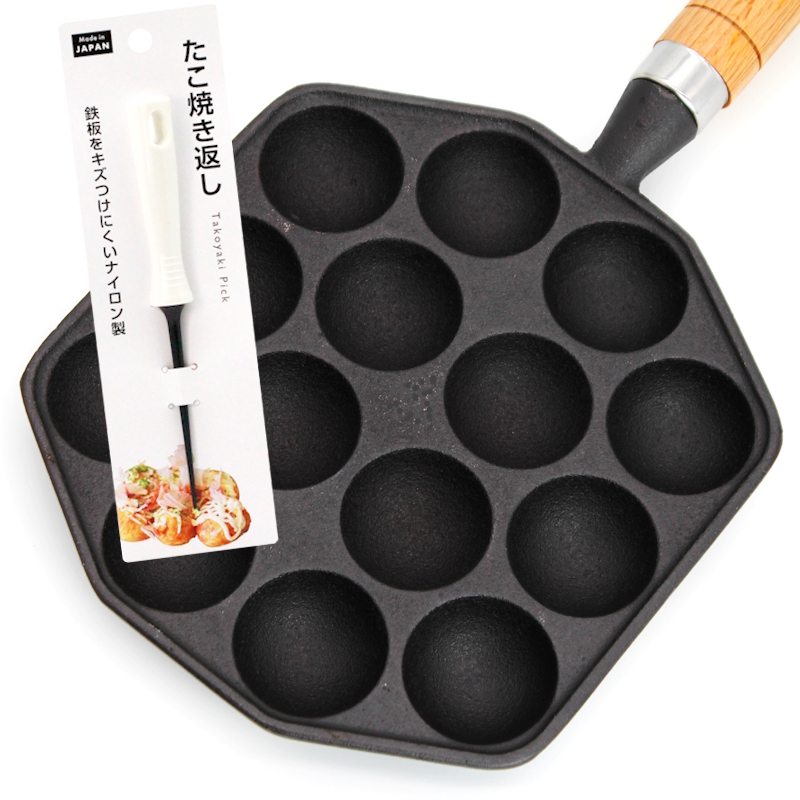
Takoyaki Pfanne (für japanische gebratene Oktopusbällchen, 14 Löcher, aus Gusseisen) + Pick
Diese Takoyaki Pfanne aus Gusseisen eignet sich ideal zur Zubereitung japanischer Takoyaki – kleiner, runder Teigbällchen mit knuspriger Außenseite und weichem Kern. Die Pfanne verfügt…
In stock
Takoyaki is not only a highlight of Japanese street food, but also a fantastic addition to any social gathering. Experiment with different fillings and discover just how versatile these small, delicious dough balls can be. Whether traditionally with octopus or creatively with other ingredients – it’s guaranteed to bring variety and a touch of Japanese flair to your kitchen.
I look forward to hearing about your Takoyaki adventures. Share your experiences and creative variations with us! We’re excited to see what new flavours you discover and what tips you might have for other Takoyaki fans.
Do you have any questions about preparation or would you like to share your successes with the community? Simply leave a comment below this post. Have fun trying out and enjoying your homemade Takoyaki!

Takoyaki
Serves 4 | 30 minutes | 339 kcal
🖨️ Print PDF 📌 Save this pinReady for a bit of fun in the kitchen? With our Takoyaki recipe, you can bring the taste of Japan into your home! Easy to make and absolutely delicious – perfect for impressing friends and family. Grab your frying pan, it’s going to be delicious!
Ingredients (serves 4)
For the batter:
130 g Takoyaki flour (im Shop ansehen)*
½ tsp Baking powder
360 ml Water (or Dashi stock (im Shop ansehen))
2 eggs
Sesame oil (im Shop ansehen)*
Filling:
75 g firm Tofu (or cooked octopus, mushrooms, al dente vegetables)
2 tbsp Katsuobushi (im Shop ansehen)*
1 tbsp Beni Shoga (pickled ginger) (im Shop ansehen)*
2 spring onions
To serve:
6 tbsp Takoyaki sauce (im Shop ansehen)*
4 tbsp Japanese mayonnaise (im Shop ansehen)*
1 tbsp Katsuobushi
1 tbsp Aonori (im Shop ansehen)*
Useful utensils:
Takoyaki pan (im Shop ansehen)*
Santoku knife (im Shop ansehen)
Preparation (30 minutes)

Step 1
Prepare the ingredients for Takoyaki. Tip: If you want to use Dashi stock, it should already be prepared and completely cooled!

Step 2
In a bowl, mix 130 g Takoyaki flour with ½ tsp baking powder and 360 ml water. Add 2 eggs and whisk everything together until you have a smooth, runny batter.

Step 3
Pour the batter into a measuring jug with a spout and set aside briefly.

Step 4
Finely chop 2 spring onions, 1 tbsp Beni Shoga and 1 tbsp Katsuobushi.

Step 5
75 g Tofu (or octopus, mushrooms, vegetables) cut into cubes of about 1 cm.

Step 6
Heat the Takoyaki pan over a medium heat and generously grease it with sesame oil . The oil ensures that the balls become crispy on the outside and can be turned easily later on.

Step 7
Fill the moulds almost to the brim with batter. Place a piece of Tofu in each mould and sprinkle with the chopped spring onions, beni shoga and Katsuobushi. Fry for 4–5 minutes until the edges are lightly browned.

Step 8
Now it gets interesting. This is where it’s decided whether your Takoyaki will turn out round. Using special Takoyaki picks (or one or two long bamboo skewers, or even two forks if necessary), carefully loosen the edges between the moulds a little. Test whether the balls can be moved by piercing the centre and turning gently. If they come away: Start turning the Takoyaki carefully. Do this using small, circular movements around the edge of the moulds. The shape is still a bit messy at this stage, which is completely normal. Simply turn the balls 90 degrees and then move on to the next one.
If they’re still sticking or the batter seems too runny, it’s best to wait another 1–2 minutes. As soon as the edges are lightly browned, the Takoyaki are much easier to turn. Very important: stay patient and don’t turn up the heat – otherwise they’ll burn on the outside whilst the centre is still raw.

Step 9
Fill the gaps in the moulds with more batter to ensure the Takoyaki are completely filled. Cook for a few more minutes, then turn them over again and press any uneven parts inwards to achieve a neat shape. After the second turn, the Takoyaki should be almost round; if not, keep turning them gently.

Step 10
Once the Takoyaki are round enough, brush them again with sesame oil and continue turning them, swapping the paler ones for the more golden ones to ensure even browning.
Step 11
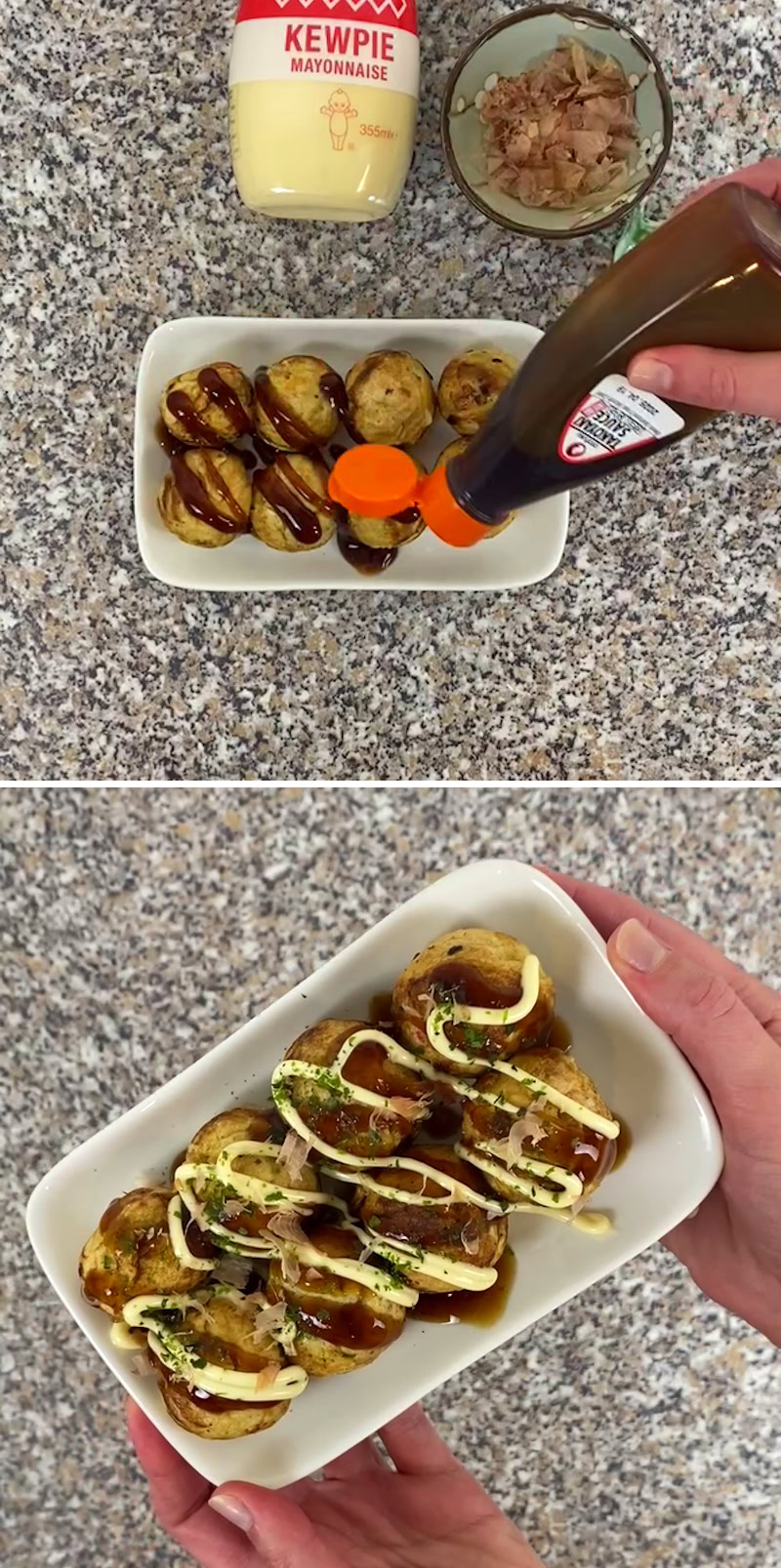
Remove the cooked Takoyaki from the pan and place on plates. Brush with about 6 tbsp takoyaki sauce, drizzle 4 tbsp Japanese mayonnaise over them and sprinkle with 1 tbsp Aonori and 1 tbsp Katsuobushi .
Repeat the whole process until all the batter and ingredients have been used up.
The Takoyaki are now ready; best served hot! They go very well with yakimeshi rice, a light Misoshiru and Japanese coleslaw.
If you’re interested in Japanese street food, check out the Japanese summer festival food. Other Japanese street dishes include:
No post found!
Have you tried the recipe? Let me know in the comments – I’m really looking forward to hearing from you.